

The Power of the Sketchbook: Why Observational Drawing Matters
The term “observational drawing” might sound intimidating, but it simply means drawing what you see, as you see it. It is one of the most critical skills we look for in applicants and one of the most valued skills taught in our Foundation Year.
Why do art colleges emphasize this fundamental practice so heavily?
1. It Teaches You to Really See
The human brain is excellent at shortcuts. When you look at a mug, your brain tells you, “That’s a mug.” When you draw it, you have to temporarily ignore that label and focus purely on shape, line, shadow, and proportion.
- It’s Not About Talent, It’s About Training: Observational drawing trains your eye to notice subtle shifts in light, perspective, and form. This translates to better spatial awareness whether you’re designing a website layout, illustrating a book cover, or animating a character model.
2. Your Sketchbook Shows Creative Discipline
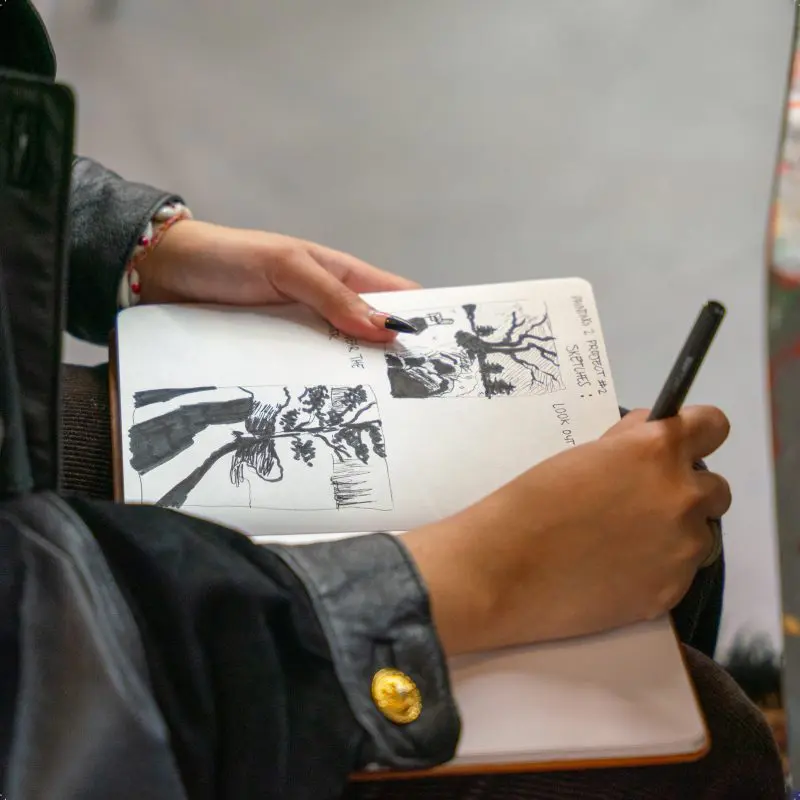
A well-used sketchbook demonstrates that you are a dedicated artist who is practicing even when there isn’t a grade attached.
- It’s a Visual Journal: It’s a place for notes, color tests, concepts, and failures. It shows us your willingness to explore ideas before committing to a final piece.
- Failure is Welcome Here: A sketchbook is the safest place to fail. Those “bad” drawings are often the necessary stepping stones to your best ideas.
3. The Digital/Traditional Connection
Even if you plan to be a digital artist (like an animator or game designer), understanding light and form through traditional observation is essential.
- Example: Character design starts with the ability to draw the human figure accurately and dynamically. Drawing from a live model in a figure drawing class builds this critical understanding of anatomy and movement.
The sketchbook is your most vital tool. Carry it everywhere—it’s where your creative muscle gets its daily workout!
Five observational drawing ideas for your sketchbook:
1. The Anatomy of Clutter
Original Focus: Still life, composition, and texture study of everyday items.
Prompt: Select an area of your home, studio, or classroom that is naturally messy or filled with objects (e.g., a desktop corner, a kitchen drawer pulled open, a shelf of cleaning supplies).
- Task: Create a detailed drawing of the arrangement, paying close attention to overlapping forms, negative space, and the cast shadows that define depth. Experiment with using a variety of drawing tools (pen, pencil, charcoal) to capture the different textures—the smooth plastic, the rough fabric, the sharp metal.
- Focus: Composition, Light & Shadow, and Depth. Colleges want to see that you can organize a complex visual field accurately.
2. The Interior Portrait
Original Focus: Perspective and atmosphere study.
Prompt: Choose an interior space—a stairwell, a hallway, or even a small closet—that features strong linear perspective (lines receding to a vanishing point).
- Task: Execute a drawing that focuses heavily on accurately rendering the one-point or two-point perspective. Use this framework to map out the furniture and architectural details. Then, draw a series of “detail shots” on the same page, zooming in on areas like a door handle, a corner of the wall, or the texture of the floor.
- Focus: Perspective and Spatial Accuracy. This demonstrates your technical understanding of how to translate 3D space onto a 2D surface.
3. The Un-Self Portrait
Original Focus: Self-exploration through objects.
Prompt: Gather three objects that are highly personal to you (a favorite pair of shoes, a worn-out journal, a beloved mug). Draw yourself interacting with the objects but only show the parts of your body involved in the interaction (your hand holding the mug, your feet in the shoes, etc.).
- Task: Focus on figure/ground relationships and foreshortening (how an arm or leg appears compressed when pointed toward the viewer). Use the texture and light on the objects to define the entire composition.
- Focus: Human Anatomy, Foreshortening, and Gesture. This is a clever way to include figure drawing without needing a full-scale model.
4. Anatomy of a Machine (or Plant)
Original Focus: Deconstruction and structural study.
Prompt: Find a complex, non-living object with many moving or interlocking parts (a bicycle chain, an old printer, an exposed engine, or the head of a sunflower).
- Task: Create a series of studies on a single page. Start with a large drawing of the entire object. Then, zoom in to draw 2-3 cross-sections or exploded views that reveal the internal structure and how the parts fit together. Use arrows and labels to annotate your observations.
- Focus: Structural Analysis, Mechanical Form, and Line Quality. This shows rigorous observation and an understanding of construction.
5. Time and Light Study
Original Focus: Capturing sensory response and atmosphere.
Prompt: Choose an object or a small corner of a room that is directly illuminated by natural sunlight.
- Task: Create a sequence of 3-4 small, timed drawings (limit each to 15-20 minutes) of the exact same subject. Focus solely on how the shape and intensity of the cast shadows and highlights change over that period of time as the light source moves.
- Focus: Value (Tone), Light as a Dynamic Element, and Speed/Economy of Line. This proves you can work quickly, capture the fleeting nature of light, and manipulate value to create three-dimensional form.
Thinking of Transferring? Your Smooth Transition to Montserrat
February 2, 2026
What It’s Like to Be a Montserrat Student
January 26, 2026
Breaking Down Art School Costs: Financial Aid, Scholarships, and Affordability
January 19, 2026
Creative Careers Are Real: Montserrat’s Creative Employment Initiative
January 12, 2026
2025: A Year of Bold Vision and Creative Growth at Montserrat
January 8, 2026